

The Chalkboard
The rituals and sacred objects of est

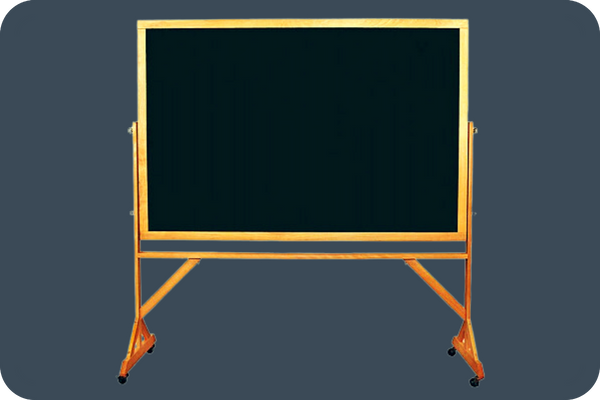
Once when I was 16 and assisting in a seminar for est graduates, I got to do the chalkboard.
It was my first time.
I was really unsure about it.
I loved the chalkboard. Like all the hallowed objects of est, it was one of the steady beams in the structure that held the world together. Like the name tags that were perfectly lined up on the welcome table, like the hotel conference chairs meticulously placed in evenly spaced rows for the participants, and like the clear, gleaming pitcher of water reliably set on a small table at the front of the room for the seminar leader — the chalkboard was an item of reassurance, weighted with meaning simply by appearing in the same prescribed, deliberate way each time we came into contact with it.
Because always handwritten on the chalkboard on stage in perfect all-cap block letters were the name and dates of the next graduate seminar you were being directed to enroll in. Or the date and location of the next est training you were being directed to enroll your friends and family in.
Those all-cap block letters appeared as precise and even as if they had been printed by a machine, yet each stroke of each letter still expressed the authenticity and craftsmanship of the human hand. Those letters held authority in the toil you could see it required to create them.
It was the job of those letters to boldly broadcast the all-important intention that was the beating heart of est: more enrollment, higher numbers, full seminar rooms.
Because you were never done. You needed the seminar you were currently enrolled in, you needed the one after that, aaaaaaaaand the one after that.
Which was how I got roped into assisting in that graduate seminar at age 16, standing on a chair, stretching a roll of masking tape across the chalkboard from left to right.
I had just done the Forum for Graduates. Werner had transformed the training into the Forum the year before; it was now est-lite. The particular Forum I was in was a special Forum for est grads, not for the uninitiated. This appealed to my insider arrogance, my us vs. them operating manual.
On the last day of the Forum — it was run over two weekends — the Forum leader spoke to me personally. “Andrea,” he called my name. I was milling about and chatting near the stage at the end of a break. He was seated on the stage in his tall canvas-and-wood director’s chair — another sacred est object. I turned to him. So excited to be singled out! What was he going to say to me?
“We’ve gotta get you enrolled in a seminar.”
I felt my heart sink.
Of course. Why did I think it would be something personal that he’d want to say to me?
And then I got my back up. Why would I need to sign up for a seminar when I just did the Forum? Doesn’t it seem like that’s enough to hold me for a while?
But I knew the drill.
“Here.” The Forum leader gave me an enrollment card to fill out, told me which seminar I should enroll in, and pointed me toward a waving assistant.
I was impressed that the Forum leader — let’s call him Scott — knew I wasn’t already enrolled in a next something. I imagined him poring over the list of 200+ participants in our Forum for Graduates and cross-referencing it with a pile of completed enrollment cards that we’d filled in with our commitment to register for the next whatever. I realized later that this task would have been handled by a team of assistants and the results reported to Scott so he could do this personal targeting.
I somehow had the presence of mind to know that Scott’s appeal felt off. He didn’t have anything to say to me, even though he called me by name. I was wise enough to recognize the agenda, but not wise enough to ignore it. A personal instruction from the Forum leader himself held a lot of influence over the likes of me, no matter how cookie-cutter I knew it was.
I talked to the assistant, as directed, but I didn’t really want to do a seminar. But never fear, the assistant was ready: There was also an option for an assisting assignment. There was only so much saying no I could do in this environment. It gets to the point where you look like the asshole. Saying no meant you were resistant, and being resistant was an infraction. I wanted approval from the hierarchy.
But how was it that there was a part of me that wanted to say no at all? Wasn’t I a true believer? How was ambivalence possible?
Well, as the years went on, there was a thought that developed in our household, at least between my mother and me, that some people took est too far. For example, the assistants on phone bank duty who called you at home to enroll you in a seminar. “No, I don’t want to do a seminar right now” was never an acceptable answer and was met with “What’s your resistance?” I would foolishly engage in this conversation for way too long. But I did maintain my “no,” and once the assistant realized I was prepared to go infinite rounds and never enroll, the call would end.
So while I believed we were all responsible for creating our own lives, and that as graduates we got it, and that non-graduates lived like victims at the effect of life rather than at the helm, I also had some awareness that the est pressure tactics could go over the top. I could outlast an enrollment assistant on the phone, but when those tactics were applied to me in person, I was a marshmallow.
So I ended up assisting at the seminar, standing on a chair, stretching a roll of masking tape across the chalkboard from left to right, adhering as I went, then stepping down, moving the chair, stepping back up, adhering again, and getting it crooked.
I couldn’t even get one straight line of tape across the board. How did people do this?
I should explain what this job was. In order for someone to write those perfect all-cap letters announcing the next seminar on the board, there needed to be guidelines. Guidelines that could be removed. Tape.
I was not a natural at this task, and my lack of confidence wasn’t a good quality for this assisting assignment. The head logistics assistant needed me to rise to the occasion and just get the job done. There was no room for mistakes; that’s not how this world worked.
Usually my perfectionism lent itself well to est assisting assignments: I was made for lining up nametags on the registration table perfectly to the millimeter; I was made for sitting by the seminar room door as a sentry, ready to receive or deliver very important notes under the door. It’s possible I was even more obsessive-compulsive than est. Which meant if I couldn’t get something done perfectly, I didn’t want to do it at all.
I came down from the chair. Someone else had to tape those straight lines and craft the perfect letters confidently transmitting the dates of the next seminar you needed to be signing up for tonight.
But there was another side to the chalkboard, too. A blank side. The chalkboard was a standard conference model, 6 feet wide, in a wooden frame on wheels that you could lock and with a board you could flip. That blank side always waited for the planned but messy sketches, mnemonics, and jargon the trainer or seminar leader would scrawl during events over the years to illustrate very important teachings.
At that time, the most recent thing I’d seen written on the back side of the board had been during the previous month in the Forum for Graduates. Scott drew a circle. Then he drew the slenderest sliver of pie in it and said, “That’s what you know you know.” He wrote the letters “KK” inside that sliver.
Then he made a larger piece of pie and said, “That’s what you know you don’t know,” and wrote “KDK” in that slice.
And then he pointed to the rest of the pie, the vast majority of the pie, and said, “That’s what you don’t know you don’t know,” and wrote “DKDK” in the pie. WHOA. “That’s the terrain the Forum operates in,” he told us.
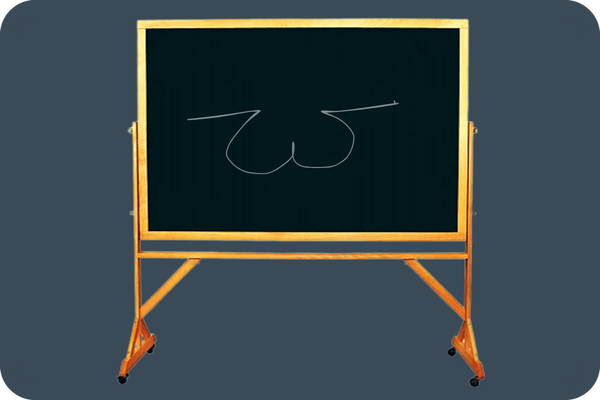
But the best stuff I’d ever seen written on the flip side of the board had been when I was younger. Things like the brilliant “W” that went along with the phrase, “You have to be willing to put your butt on the line!”
The first time I saw that one was at an SGS (Special Guest Seminar) when I was about 12. When the trainer boomed that sentence from the stage, I was spellbound. He started by saying, “You have to be,” then placed his chalk on the board and began drawing a line from the left, timed perfectly as he said the word “willing.” His drawing hand then curved down to render two rounded sections as he belted out, “to put your butt.” Then, while coming back up with the chalk and drawing a line to the right, he bellowed, “on the line!” His artwork was essentially a butt hanging from a clothesline.
Another impressive chalkboard trick I witnessed at an SGS around that time illustrated the trainer’s point about how we all think we’re observing the world around us and the people in it accurately, but it turns out… we’re not! He wrote some words on the board and told us to read them out loud. I totally fell for this one.
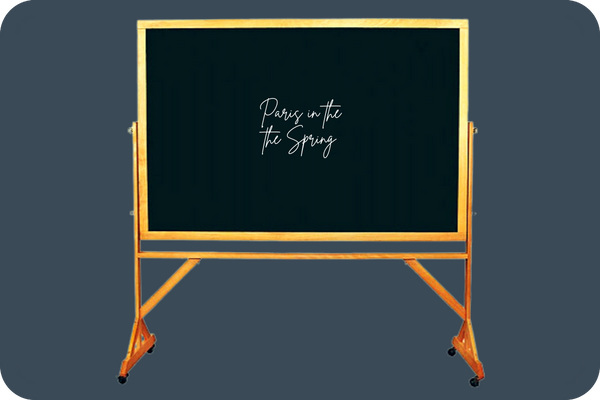
“Paris in the spring!” I shouted with most of the room. I was so embarrassed when he read the words out accurately for us afterward. He really showed us!
Oh, the chalkboard!
But I’d first met the reverse side of the board in my own training when I was 9 years old, when the trainer scrawled “VICTIM” on it and told us we were regularly performing our victim act for our parents and others in our lives when we did all those annoying things that kids do.
Labeling children’s whining and complaining with a new term — victim act — placed the whining and complaining within a philosophical framework and assigned a conscious intention to it. Rather than being an annoying but developmentally expected way children sometimes communicate apprehension, discomfort, anxiety, or displeasure to adults, it’s now a deliberate behavior strategically executed by a young person who’s been transformed, a young person who knows that this behavior breaks the most fundamental rule of life — that you are responsible for your experience — and all that that can possibly entail.
This rule, and many other lessons of est, resided in this object for me — the chalkboard. While the ubiquitous est name tags always located me securely inside the us of the us vs. them construct I lived by, the chalkboard embodied the authority and reach of est’s philosophy, which I understood simply as what was true. To look at the chalkboard for me was to know that children create their lives.
Years later, when I was an adult and the scales had fallen from my eyes, I attended a Special Evening about the Successor Program (not its real name) in San Francisco to indulge in nostalgia. It delivered.
The Successor Program was the direct descendant of est. The Special Evening about the Successor Program was the equivalent of est’s Special Guest Seminar (SGS), an evening event where graduates bring their guests to give them the opportunity to enroll.
Everything at the Special Evening about the Successor Program was the same as the est of yore. The smiling, hyper-engaged assistants, the name tags that were perfectly lined up on the welcome table, the hotel conference chairs meticulously placed in evenly spaced rows for the participants, the gleaming pitcher of water reliably set on a small table at the front of the room for the seminar leader, the tall director’s chair on stage, the enrollment cards, the jargon everyone spoke in, the message the leader delivered, the participants blaming themselves for things they couldn’t possibly have been responsible for in their dramatic and emotional shares on the mic.
And the chalkboard. Broadcasting those perfectly written names and dates of the next program to enroll in.
Somewhere in the room was the assistant who had labored at that flawless lettering.
During that evening — and this was just after the turn of the century — the Special Evening leader flipped the chalkboard to the reverse side to illustrate his very important teaching. He drew a circle. And then he drew a small triangle of pie into that circle. Oh, it’s going to be a pie chart. And then he pointed to that small piece of pie and said, “This is what you know you know.”
As he proceeded to draw the same pie chart on the board that Scott had wowed us with at the Forum for Graduates in the ’80s, complete with the labels KK, KDK, and DKDK. I looked around the room at the rapt attendees donning their graduate name tags. I fell dreamily into the entrainment of the leader’s voice, for it was the familiar cadence of every est trainer and seminar leader from my youth, and ultimately of Werner. Here at the Special Evening about the Successor Program, I was ensconced in all the old familiars, immersed in the rituals, rhetoric, and sacred objects of est.
And in the beating heart of that room, from somewhere in the back on the right, a man asked a question. The floor had been opened up to questions from guests. Guests were non-graduates, which means them, not us — but a them who you want to transform into an us.
The guest asked whether the Successor Program was related to the est training and Werner. The Special Evening leader stated that the Successor Program and est are unrelated. He added that he thinks Werner Erhard’s a great guy, a great man whom he respects, but Werner Erhard is not affiliated with the Successor Program. The Successor Program and est are two completely different things, he said.
As I looked again at the chalkboard, at the Werner pie chart copied here as a core element of the Successor Program, I wondered why the Special Evening leader was lying to the room. I’m kidding. I knew exactly why he was lying to the room. At that time, Werner was still living outside the country avoiding a host of scandals, and the Successor Program wanted to distance themselves from Werner publicly while they actively used his intellectual property that they licensed from him.
The Special Evening leader flipped the chalkboard back to the side with the dates of the next Successor Program. Assistants descended. Enrollment cards were handed out.
At the time, I was still deprogramming myself. I was simultaneously both repelled and compelled by anything remotely est (which included certain things Oprah was saying, and virtually everything Dr. Phil was doing on Oprah’s show at that time – subject for a separate post).
I was publicly but quietly performing my deprogramming on the coziest stages in San Francisco: Climate Theatre, Z Space, The Marsh, Venue 9. I was placing the ritualized language (jargon) of est on stage along with select sacred est objects and a verbally conjured chalkboard. I was compelled and repelled, trying to live in “both/and,” as I put it at the time, rather than “either/or.”
Solo performance expanded into playwriting as the good, the bad, and the ridiculous of my est childhood emerged as a comedy for four actors and a chalkboard. Yes, I grew up to write a play in which I placed the objects and language of est on stage in a ritualized deprogramming. Objects and language that transformed themselves in performance from signifiers of an us vs. them worldview and a nonsense philosophy, to objects of play and liberation.
I kept the chalkboard from the first production of the play. Housed it in my string of New York City apartments, disassembled, the dismounted board variously against a wall, above the couch, and as a headboard. And the stand and hardware in pieces in various closets. Finally got rid of the stand and hardware during the covid clean-out.
But the board itself — it’s right here in my apartment. I’m less than 10 feet away from it as I write this.